 Webmaster
May 21, 2014
Webmaster
May 21, 2014
OPINION: Unravelling The Nigerian Paradox

No one doubts that Nigeria is a (potentially) wealthy nation. Here is a country that ranks among the top 10 oil producers or exporters in the world and is now the largest economy in Africa.
Besides, Nigeria has the largest corps of trained professionals in Africa, some of whom were loaned to other African countries at the dawn of independence. Today, many of these professionals are scattered throughout the world, contributing to growth and innovations in education, health care, business, engineering, and technology, wherever they are.
Paradoxically, Nigeria is also among the “extremely poor nations” on earth, when the focus is on the number of citizens living in abject poverty. Nigeria also ranks very low on the Human Development Index, especially in life expectancy and in the quality and distribution of political goods. Moreover, Nigeria’s unemployment rate is among the highest in the world. It is not enough to explain this paradox in terms of the concentration of the nation’s wealth in very few hands, leaving the rest of the population to scamper for the crumbs.
Amplifying the paradox is the wide gulf between the nation’s oil wealth and the quality of political goods made available to the citizens by the political class. This gulf is particularly evident in poor infrastructure and inadequate investment in education, health care, and social welfare.
The trio of poor leadership, weak institutions, and corruption is often blamed for the existence of this gulf. Some have argued that once corruption is removed, all will be well with Nigeria. But then, strong leadership is needed to reduce or control corruption. The strongest of institutions can be weakened by poor leadership, thus allowing for various loopholes that allow corruption to thrive. Although this is the situation at the federal level, there are a few states that paint a different picture.
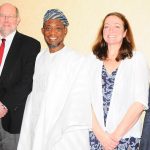
Against the above backgrounds, I was curious about the maiden edition of the Business World’s Most Innovative Governor Award, which celebrates innovative approaches to governance and development. The ceremony held at the expansive Zanabab Hotel and Resort in Ilesa on Saturday, May 3, 2014. After a survey of first-term governors across the country, 12 were shortlisted for the award, two from each geopolitical zone. A team of experts was despatched to each state to document and assess major innovations in governance as well as the nature and extent of development. After all the data were assessed, analysed, and compared, Governor Rauf Aregbesola of Osun State emerged as the overall winner.
After verifying the innovative programmes identified in the award citation and brochures, I decided to share the award experience for at least two reasons. First, in performing the traditional functions of the Fourth Estate, the press must be careful not to be seen only as a one-eyed critic, who sees nothing beyond the government’s shortcomings. The other eye must be opened to see good models that are driven by innovations. Indeed, if the goal of critical commentaries is to provide the basis for desirable social change, then good models, typified by innovative programmes, deserve our attention. I made the same argument when I wrote about Dr. Olusegun Mimiko’s innovative health, education, and community development programmes in Ondo State during his first term.
Second, there has been so much negative press about Aregbesola, due partly to his initial over-enthusiastic approach to governance and partly to his outspokenness on the issues he cares about. As a result, his achievements have been overlooked, misrepresented or completely distorted.
One such achievement is his wide-ranging education reform, which is beyond school mergers and reclassification of grade levels into Elementary, Middle, and High Schools as reported in the media. It also involves the provision of lunch for Elementary grades, textbooks for Elementary and Middle grades, Opon Imo(Tablets of Knowledge) for High School grades, and uniforms for all grades and for the food vendors in all Osun schools. These innovations are complemented by a massive construction of distinctive mega schools. On completion, 100 Elementary, 50 Middle, and 20 High Schools would have been built. Furthermore, the teachers’ morale is boosted by capacity building programmes, rewards for excellence, and transparent promotion exercises. Appropriate security and quality assurance measures were also set up for all schools throughout the state.
A unique feature of the state government’s education reform is how well it dovetails into the provision of employment for contractors, building materials suppliers, daily wage labourers, food vendors, farmers, tailors, and youths. For example, the garment factory established for the production of uniforms, the food vending project, and the empowerment of farmers and youths for food production to feed the schoolchildren have generated nearly 10,000 employment opportunities across the state.
Furthermore, Aregbesola’s innovative approach to employment led to the establishment of a popular youth employment scheme, which recruits at least 20,000 youths, who are deployed to various jobs for a period of three months, at the end of which some are permanently recruited by the state and a new batch comes on board. The youth employment scheme is complemented by a social security programme for vulnerable adults throughout the state, who are paid a monthly allowance and provided with free medical care.
Realising that farming provides employment for many Osun residents, Aregbesola embarked on a massive, but highly integrated, road construction and rehabilitation projects across the state, including boundary highways; township roads; inter-city roads; rural roads; and a 17-kilometre, dualised, ring road around Osogbo. Where necessary, untarred roads are opened up by direct labour to provide access to remote farms.
Furthermore, to facilitate the movement of goods to Lagos, which has the largest concentration of consumers of Osun goods, a new road project was embarked upon, linking Osun with Ogun State along the Gbogan-Odeomu-Ijebu Igbo axis. The railway station in Osogbo is undergoing massive restructuring not only for the movement of farm produce but also for the movement of passengers, especially during festive occasions when the state provides free rail transport.
According to Muyiwa Ige, the state Commissioner for Lands, Physical Planning and Urban Development, the station is being developed in terms of the Chicago Michigan Avenue concept of the Magnificent Mile, connecting the station with Osun River, the Old Garage, and Omiseke. The transport network is capped by an airport, whose 3.2-kilometre runway and Tower are under construction.
Because many of the innovative projects are visible throughout the state (see Business World, Vol.8, No 22, May 5-12, 2014 for details), let me highlight an invisible one that really drives the wheel of efficiency and transparency in project execution throughout the state. It is the Bureau of Social Services, the first of its kind in the country, established by Aregbesola and headed by Femi Ifaturoti, an engineer and Project Assessment Manager. BOSS is staffed with administrators, engineers, architects, quantity surveyors, and IT specialists.
According to Ifaturoti, “The mission of BOSS is to leverage human resources and technological innovation in driving effective monitoring and evaluation of social service delivery, thereby ensuring public val
ue and fiscal discipline”. BOSS functions as a conduit between the governor and the commissioners, by monitoring and evaluating all state projects and ensures that comparative data on all projects are collected, analysed, tabled, and archived, thus facilitating quick checks of project status and comparisons across similar projects. The monthly evaluation meeting between BOSS and state commissioners keeps commissioners on their toes, while leaving the governor free to pursue other ways of improving citizens’ life chances.
Aregbesola’s innovative projects have attracted partnerships from local and international organisations, because they are functional and cost-effective. And BOSS drives them to successful implementation. That’s why he has been able to achieve so much in so little time. This has helped unravel the Nigerian paradox.
THE PUNCH