 Webmaster
July 18, 2014
Webmaster
July 18, 2014
FEATURE: Like Osun, Like Benin

When the Osun State Government re-classified primary and secondary schools into elementary, middle and high schools in 2012, many pooh-poohed the policy. But, a visit to Benin Republic has shown that the system is not strange, after all, reports SINA FADARE
RE-CLASSIFICATION
It is a policy those in the opposition love to hate. When the Osun State Government reclassified schools in 2012, they descended on the Rauf Aregbesola administration, describing the policy as a ploy to destroy education. But, there is nothing strange about the policy which is also being implemented in Benin Republic.
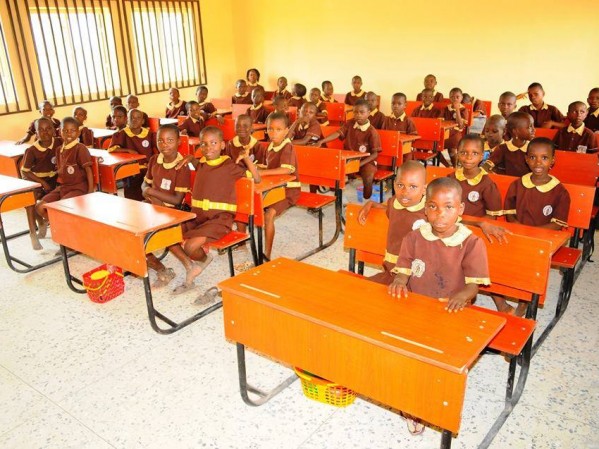
In the exercise, primary schools were renamed elementary schools, and stopped at Grade 4 (Primary 4) instead of the former Primary Six. Junior Secondary Schools are now called Middle Schools and have pupils from Grades 5 to 9 (Primary 5 to Junior Secondary School 3); Senior Secondary Schools were replaced with high schools catering for SS1 to SS3 pupils.
For smooth implementation, schools were merged along the various levels. The elementary schools accommodate 900 pupils; middle schools between 900 and 1,000; the high schools are designed to accommodate 1,000 for each of the three grades 10-12 (SS1-SS3).
The government also introduced school uniforms for the three levels. In the public school system, only three uniforms exist, irrespective of the school’s location.
Justifying the re-classification, Governor Rauf Aregbesola said the system was introduced to reposition education, which was in a sorry state when he took over in November 2010.
His Deputy and Commissioner for Education, Mrs Titi Laoye-Tomori, said the system was tailored after the American education model, which advocates that children of the same age group should learn together.
Nevertheless, criticisms trailed the exercise. Last year, there were protests in Osogbo, the state capital, and other areas over the policy. The protests had religious undertone. Christian groups were opposed to the merger of schools founded by missionaries with Muslim schools and vice-versa. There was also disaffection over the change of single-sex to co-education schools under the policy.
In Benin, which borders Nigeria on the west, the same policy is being run. As in Osun, schools are classified as elementary, middle and high schools. All the schools also wear the same uniforms. Benin’s was adopted as a national policy following an Educational Forum in 2007. Mrs Laoye-Tomori explained that Osun adopted the policy following recommendations of a summit held in February 2011, which sought the repositioning of the education system such that pupils would enjoy quality education, irrespective of their background.
Benin’s Minister of Education (Secondary) Fructeuex Sylvan, said the country’s policy was adopted because of the interest in creating an egalitarian society where the children of the rich would not have access to quality public education at the expense of the poor.
Like Osun, Benin also faced opposition over the policy, but of a different kind.
Fructeuex said some powerful and rich people wrote to the government to discontinue the policy.
“But the government was resolute to make a success of it by providing equal platform that reduces the gap of human capital development,” he said.
The policy, he said, would last till 2025 before it could be reviewed for continuity or change.
But, Benin did not have problems with religion like Osun. In Benin, Fraucteuex said, religion has no place in educational policy neither are religious scholars given any prominence. There are Christians, Muslims, and adherents of African Traditional Religion throughout the country. Most adherents of the traditional Yoruba religious group are in the south of the country; other African Traditional Religion beliefs could be found in the north. Muslims are mostly concentrated in the north and southeast. Christians are prevalent in the south, particularly in Cotonou, the economic nerve centre of the country. These religions do not interfere with the education.
But, there are differences in the operation of the policy. Benin’s differs from Osun’s in that at the elementary level, pupils spend six years and not four; four years middle school rather than five; four years in high school as opposed to three. In all, the pupils spend 13 years in primary and secondary schools in Benin the Osun’s 12.
Language of instruction is also different. In Benin teaching is in local languages, spiced with little or no French as the official language. But, in Osun, like most part of Nigeria, teaching is in English right from the elementary stage.
UNIFORMS
there are, however, similarities in school uniform. According to Director of programmes of the National Radio/Television, Marcelle Brigitie Adelakoun Ipaur Houssou, the practice preceded the 2007 education reforms.
“All schools in Benin Republic since independence wear the same Beninoisie khaki. While the primary school pupils wear knickers, the secondary school pupils wear trousers. All the students have the badges of their schools on their uniforms. There is no room for the use of any unconventional dress like hijab, beret, etc, in any public school in the country,” she said.
Fructueux said the policy was introduced to achieve equality in the school system.
“The schools started using the same uniforms since independence, thereby creating a level of egalitarian lives among the students. The Government of Benin Republic has made it difficult to distinguish between the child of the rich and the poor. It is this policy that made the government to declared education as free and compulsory in the country since 2007. The rich who want to send their children to private school are free to do so,” he said.
He said the country did not experience crisis as far as uniforms are concerned. However, he said parents buy the uniforms. In Osun, the government collaborates with a private contractor to produce the uniforms.
“The uniform is bought by the parents but the model of sewing is provided by the Government through the schools as the rules must be followed,” he said.
Osun and Benin also practice free education up to high school.
School feeding
Osun has a robust feeding programme for all its elementary schools which costs N3.6 billion yearly. Mrs Laoye-Tomori said the project started with the feeding of 155,318 Grades 1 to 3 pupils in April, adding that it was expanded to include Grade Four pupils. By December 2013, she said enrolment had increased by 25 per cent.
“The data presented by the National Bureau of Statistics, by December 2013 shows that the State of Osun has the highest enrolment figure of public primary school pupils in the country,” she said.
In Benin, school feeding is only done in the rural areas to encourage poor parents to send their children to school. This, according to the Minister, led to an upsurge in enrolment of pupils in public schools by 100 per cent.
Reforms: to be or not to be
Given the challenges the education reforms in Osun have faced, the question is whether they should be continued or scrapped. Educationists who spoke with The Nation favoured the new policy but called for proper implementation.
For Mrs. Foluke Akintunde, a teacher in the state, the reforms are welcome because they have improved school infrastructure.
“As an insider who has put in about 22 years of teaching in various schools across the state, l can authoritatively say that some of the schools were not equipped. If the on-going policy will give a face lift to the poor infrastructural amenities in most of the schools, it is a welcome idea,” she said.
An executive of the All Nigeria Conference of Principals of Secondary Schools (ANCOPSS) in the state, Mr. Olu Adepegba, says implementation is key.
“The initial inconveniences notwithstanding, if you are expecting better equipped schools, we should support the government so that all what it has on the drawing board would be achieved in not too long a distance. I am sure the policy will open a new window of opportunity for the children of the state who will be educationally equipped to challenge their counterparts anywhere in the world,” he said.
A former Dean of the Faculty of Agriculture at the Obafemi Awolowo University, Ile- Ife, Prof. Olasupo Ladipo, who hailed the policy said it would enable the government to equip the schools better.
His words “There are too many schools which are not well -equipped. Education is expensive and schools should be well-equipped to enable students have access to quality education.
“There are too many schools which are not well -equipped. Education is expensive and schools should be well-equipped to enable students have access to quality education.”
THE NATION