 Webmaster
October 31, 2016
Webmaster
October 31, 2016
Aregbesola’s Strategy Of Managing Inherited Osun Debt
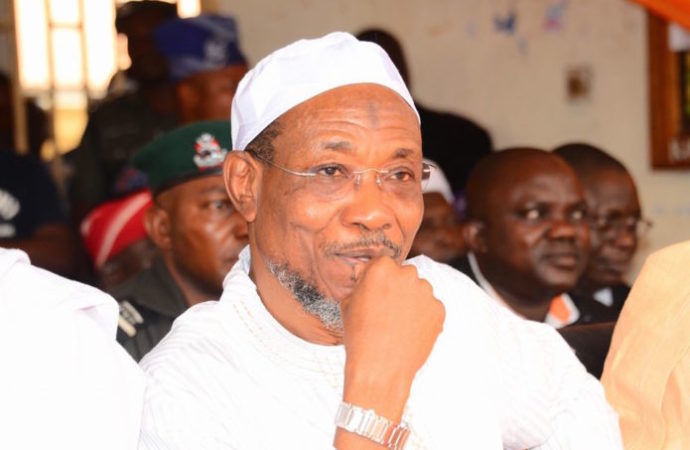
It is almost 6 years that Osun state governor, Ogbeni Rauf Aregbesola has been steering the affairs of the state. He was returned to office in November 27, 2014 for a second term. So many things can be said to have be achieved by Ogbeni’s 6 year old administration in the state. No doubt, Governor Aregbesola met the state in debt with abandoned projects in the state. Governor Aregbesola took only sukuk loan at zero percent interest rate for 11 High Schools project that have direct impact on the lives of the people. He has worked on roads, flyover and airport construction. Whoever made an allegation of huge borrowing is not fair to Aregbesola. Aregbesola has explained that he inherited debt and a state that was in comatose and in dire need of infrastructure due to years of neglect that had forced government and business in Osun State to a standstill.
From Debt Management Office (DMO) 2015 Annual Report, the total public debt outstanding between 2008- 2015 for external stock rose. The total debt service the same period saw the percentage of external debt service drastically reduced from 11.46 per cent to 5.96 per cent while the percentage of domestic debt servicing grew, drastically increasing the cost of the total debt service since the cost of domestic borrowing is atrociously higher than the cost of external borrowing and this is Aregbesola’s strategy of managing Osun inherited debt. How could your debt sustainability analysis rationalize this without seeing some narrow interests being the overriding reason? Could this be the explanation why commercial banks in the country are declaring unheard-of three digit profits and the high Foreign Portfolio Investment and low Foreign Direct Investment?

It’s an established fact that the willingness and ability to borrow do not automatically translate into economic growth. If you agree with this fact, how productive are the country’s recent borrowings? Governor Aregbesola has observed that our internal debts continue to represent more than two-thirds of Nigeria’s external debt profile, when the cost of servicing domestic debts is ridiculously far more expensive than servicing external debts. Governor Aregbesola has questioned government continuous borrowing internally when in so doing results in insufficient funds, skyrockets the cost of borrowing and above all, crowds out the real sector from the money market? Shouldn’t the high cost of domestic borrowing override whatever are the assumed benefits? Since both London Interbank Offer Rates (LIBOR) and the US Treasury Bonds rates offer far better interest rates for sovereign borrowings, why have we continued not to take advantage of cheaper interest rates?
Osun State raised a sukuk bond worth N10 billion (some $62 million) from the capital market to fund educational development – the first of such by Africa’s biggest economy. Governor Aregbesola is aware that Islamic financial instruments such as sukuk which attract zero percent interest have been used to finance infrastructure projects in countries like Malaysia and Indonesia, and in the Middle East, and could attract investors from such countries. The governor knows that Islamic finance requires a clear link with real economic activity and transactions have to relate to a tangible, identifiable asset, which comes in handy in the case of infrastructure financing. Governor Aregbesola strategy in managing Osun Debt ordered the issuing a sovereign sukuk will send a much needed positive message to the market amidst the negative investor sentiment that persists currently. He expressed confidence that Nigeria’s maiden sovereign sukuk which will be oversubscribed as both domestic and foreign investors have appetite for exposure to Nigeria. He therefore urged the DMO to take advantage of this unique opportunity to make a mark on the sukuk market in spite of the challenging times.
In a bid to secure debt relief for inherited debt that will free up funds to meet their financial obligations to workers, contractors and other debtors, Osun, and other states have topped the list of 11 states, which have issued federal government bonds (FGN Bonds) to 14 commercial banks under a debt-restructuring programme facilitated by the federal government. The 36 states of the federation had approached President Muhammadu Buhari in June to ask for a bailout that would enable them pay salary arrears to their employees and meet other pressing obligations. Seizing on the opening, 22 states of the federation have applied to the Debt Management Office (DMO) for their debts to be restructured into FGN Bonds. The Director-General of the DMO told the Nigeria economic council that based on the approval of the president on the plan to restructure bank loans of the states into FGN Bonds in order to address their fiscal imbalance, 22 states submitted reports and applied for restructuring as at August 19.
Governor Aregbesola has studied Osun low multilateral debt which is the total amount of money that Osun State owes to international financial institutions, such as the World Bank and the International Monetary Fund (IMF). Governor Aregbesola only took sukuk bond to build 11 High Schools and no other loan . For details of Osun State Sukuk projects go to www.osunsukukprojects.com to see eleven wonders of Governor Rauf Aregbesola. These financial entities insist that the repayment of multilateral debt become a priority and hold precedence over any other outstanding loans.
Governor Aregbesola equally studied Osun State bilateral debt which is a simple loan arrangement between Osun Stateand a single lender. Such loans are called “bilateral” because there are only two parties to the loan, each with an obligation to the other: One will provide a specific amount of money under the terms of the loan agreement, and the other will repay the money as provided for in that same agreement. Osun sukuk is under multilateral debt. According to DMO the country’s public debt-to-Gross Domestic Product remained sustainable as a result of the insightful management of the debt portfolio, even in the midst of crude oil price slump. Osun debt continues to be sustainable in line with IMF debt sustainability threshold, despite all these volatilities in the international capital market and the collapse of oil prices. The people of Osun State have nothing to fear over the level of Osun debt and its management, but should see this period as the time to work harder to grow the economy. Osun Sustainable debt has allowed the state to meet its current and future debt services obligations in full, without recourse to further debt relief or rescheduling, avoiding accumulation of arrears, while allowing an acceptable level of economic growth or without compromising growth. Osun has met IMF debt sustainability threshold which is a measure of Osun solvency, that is, to ensure that accumulated debts are serviced without defaulting and she is able to sustain her debt servicing overtime Generally,Osun has a borrowing space under the International Monetary Fund (IMF) debt sustainability threshold of 45% for which Nigeria and other low-middle income countries are.
Since he was sworn as Governor of Osun State in 2010, Governor Aregbesola had publicly announced the need to reduce the recurrent expenditure so that more money would be made available to capital spending which is critical to growing and diversifying the state’s economy. How far has Osun government succeeded in making these necessary cuts; and where exactly have these cuts been made in this effort to reduce recurrent expenditure? In other words, based on real amount spent on capital expenditure, how much reduction was made from 2011- 2016? Governor Aregbesola introduced sukuk as a debt management strategy that the percentage of external debt service drastically reduced while the percentage of domestic debt servicing grew, drastically increasing the cost of the total debt service since the cost of domestic borrowing is atrociously higher than the cost of external borrowing. Governor Aregbesola observed that sukuk attracts zero percent interest. Governor Aregbesola has identified factors such as increasing government spending, reforms initiatives, a low interest rate environment and high liquidity are conducive for a vibrant Islamic debt capital market in the country. Also, with investors shunning equity during the past few years due to volatility, equity capital raising activity has slowed down drastically over the last three years. Hence, governments and corporates are increasingly tapping the debt market, especially Sukuk, to fund expansion plans. In addition, a low interest rate regime has reduced the attractiveness of conventional deposits, but is making Sukuk an alluring investment alternative.
The federal government has unveiled a new debt management strategy partly in line with sukuk 2013 as introduced by Governor Aregbesola to run from 2016 – 2019 aimed at a marginal increase in external borrowing and increased commitment to capital projects execution. The DMO boss explained that the focus of the new initiative is to develop a debt management strategy that would ensure that in the face of macroeconomic and other financial constraints, the cost and risk profile of the public debt portfolio remains within acceptable limit over time.
The federal government has unveiled a new debt management strategy partly in line with sukuk 2013 as introduced by Governor Aregbesola to run from 2016 – 2019 aimed at a marginal increase in external borrowing and increased commitment to capital projects execution. The DMO boss explained that the focus of the new initiative is to develop a debt management strategy that would ensure that in the face of macroeconomic and other financial constraints, the cost and risk profile of the public debt portfolio remains within acceptable limit over time.
DMO boss reiterated that that the strategy is in line with President Muhammadu Buhari’s vision to generate maximum employment, reduce poverty and increase the living standard of Nigerians. He said, for this to be effectively achieved, the government is making positive efforts in diversifying the economy as against the backdrop of structural collapse in oil prices and oil revenue. Nwankwo said: “The Debt Management Strategy we are going to pursue over the next four years, takes into account the fact that for now Nigeria’s public debt portfolio is dominated by domestic debt. After the Paris and London Club exits between 2004 and 2006, the country took a deliberate decision to develop its domestic bond market and to do most of the public borrowing from domestic sources so as to develop the domestic bond market, that objective has been sufficiently achieved.
“And therefore taking into account that external financing sources are on the average cheaper than domestic sources, it becomes more necessary to slant more of the borrowing in favour of external sources. “Therefore one of the major elements of this strategy is that over the medium, term we will strive to remix the public debt portfolio from 84 per cent domestic and 16 per cent external to 60 per cent domestic and 40 per cent external.
“And therefore taking into account that external financing sources are on the average cheaper than domestic sources, it becomes more necessary to slant more of the borrowing in favour of external sources. “Therefore one of the major elements of this strategy is that over the medium, term we will strive to remix the public debt portfolio from 84 per cent domestic and 16 per cent external to 60 per cent domestic and 40 per cent external.
Justifying the decision to remix in favour of external debt like what Governor Aregbesola did by introducing sukuk, he said the country would be able to achieve cheaper cost of funds, lower debt servicing and avoid the risk of crowding out the private sector from accessing the domestic market, adding that the private sector is still expected to play the lead role to compliment government’s effort. While dismissing concerns on government’s decision to focus on external borrowing in a country currently facing foreign exchange constraints and harsh macroeconomic environment, he stressed that the new strategy is the best for the Nigerian economy as the government is presently making sustained efforts on diversifying the economy, noting that in the next 5-7 years export proceeds accrued to the economy will be more and our exchange rate will be favourable.
When the SEC released rules on sukuk issuance in 2013, the State Government of Osun took advantage of the robust regulatory framework to issue Nigeria’s first sukuk in which it raised N11.4 billion as a strategy of managing Osun debt. While engagements were carried out to enlighten other state governments to raise funds needed for development by issuing sukuk, an issuance of a sovereign sukuk by the Federal government will help to provide a benchmark for such issuances and spur further interest from other categories of issuers.
The Director General, Debt Management Office, DMO, Dr. Abraham Nwankwo, had different fora disclosed that the debt profile of Osun State is ‘sustainable’. But according to the director-general of the DMO who had commended the governor for being a trailblazer in this regard. The DMO director-general promised to encourage sukuk issuance in Nigeria which was introduced to Nigeria by Governor Rauf Aregbesola. Osun debt profile was a sustainable one and was healthy for the economic growth of the state. The DMO boss averred that the state needed to be encouraged in terms of management of debt, adding that Osun has not borrowed beyond its capacity.
The opposition parties in Osun State had claimed that Osun debt profile is not sustainable but the Director General of DMO has proved them wrong. DMO and others are working hard to introduce Sukuk in Nigeria; The Director General of DMO said he was delighted that Osun took the initiative and helped introduce it in Nigeria. By this, Osun is one of the best states in public debt management,” he said. Nwankwo who did not give the figure on the actual debt explained that the state needed to be encouraged in term of the management of debt because it had not borrowed beyond its capacity. According to the director-general, the nation’s debt GDP ratio has fallen from 22 per cent to 13 per cent. He said, “Our debt is sustainable because the GDP is much lower now. However, in spite of that, government will continue to be very prudent, conservative in its spending.